Pair a 3-Piece Suit with Dress Shoes: 10 Essential Rules Every Stylish Man Must Know
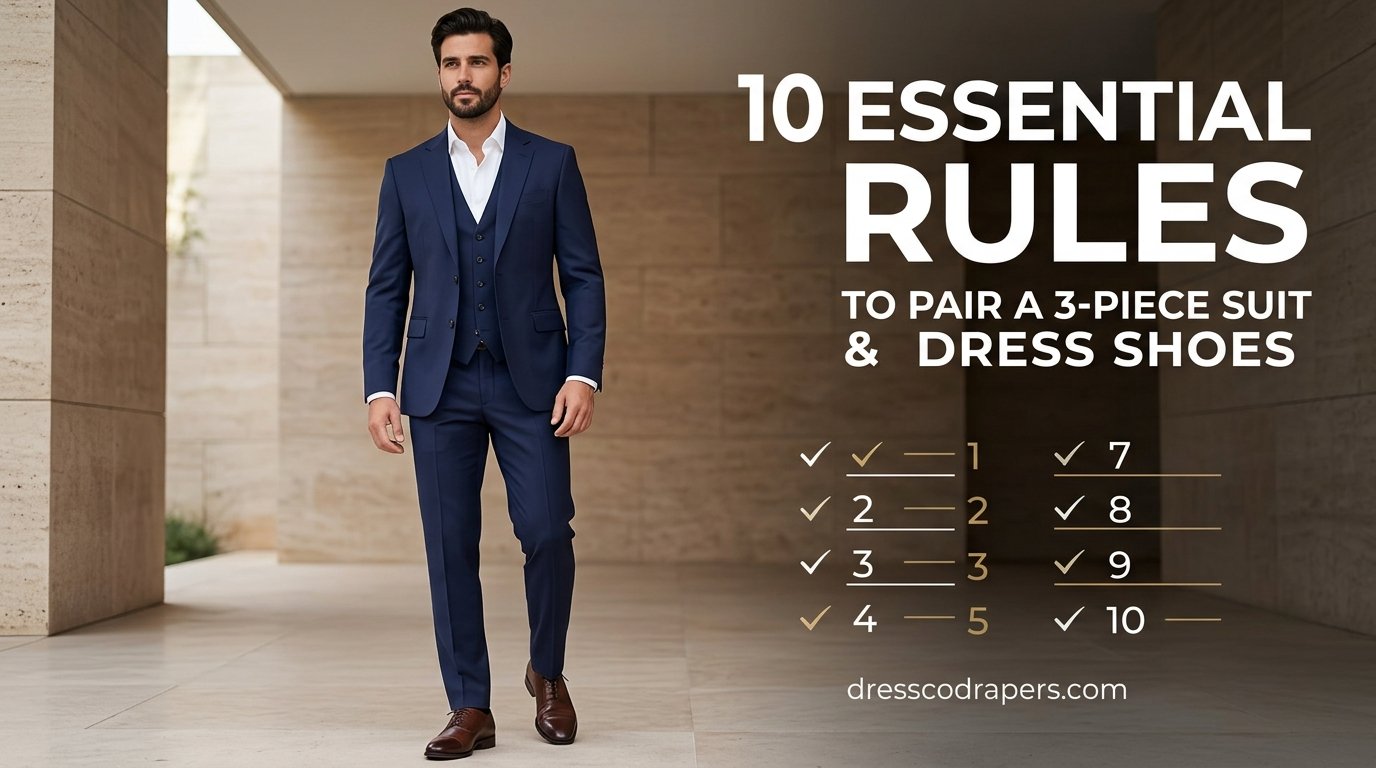
Knowing how to pair a 3-piece suit with dress shoes is what separates a man who wears a suit from a man who commands one. The waistcoat introduces a third layer of visual structure that elevates the entire outfit — but that elevation only holds if the foundation is right. And the foundation is always the shoes.
Most men treat shoe selection as an afterthought. They invest in fabric quality, obsess over lapel width, fine-tune the waistcoat fit — then slide on whatever leather shoes happen to be nearest the door. The result is a visual disconnect that undermines hundreds of pounds of careful tailoring.
This guide eliminates that disconnect permanently. Below, you’ll find 10 precise, expert-backed rules for matching dress shoes to every 3-piece suit configuration — organised by colour, formality, pattern, and occasion.
Why Shoe Choice Matters More With a 3-Piece Suit
A two-piece suit offers some margin for error. The visual weight is distributed between two garments, and the eye moves quickly from jacket to trouser to shoe without lingering.
A 3-piece suit changes the equation. The waistcoat draws the eye inward and upward, creating a vertical column of tailored elegance. When the gaze eventually reaches the feet — and it always does — the shoes must deliver the same level of intentionality.
Tailoring experts agree that the shoe-suit relationship operates on a principle of formality equilibrium. Each element must occupy a similar position on the formality spectrum. A full-canvas, peak-lapel 3-piece suit in Super 130s wool paired with rubber-soled casual loafers creates a jarring imbalance that no amount of accessorising can correct.
10 Essential Rules to Pair a 3-Piece Suit with Dress Shoes
Rule 1: Match the Formality Tier Precisely
The industry standard for 2026 ranks dress shoes on a five-tier formality scale. Your 3-piece suit’s formality level must align with the corresponding shoe tier:
Formality Level
3-Piece Suit Context
Recommended Shoe
Tier 1 — Black Tie
Formal evening events
Patent leather Oxford or Opera pump
Tier 2 — Business Formal
Boardrooms, client meetings
Black or dark brown Oxford cap-toe
Tier 3 — Professional
Office, presentations
Brown Oxford or single monk strap
Tier 4 — Smart-Casual
Summer events, dinners
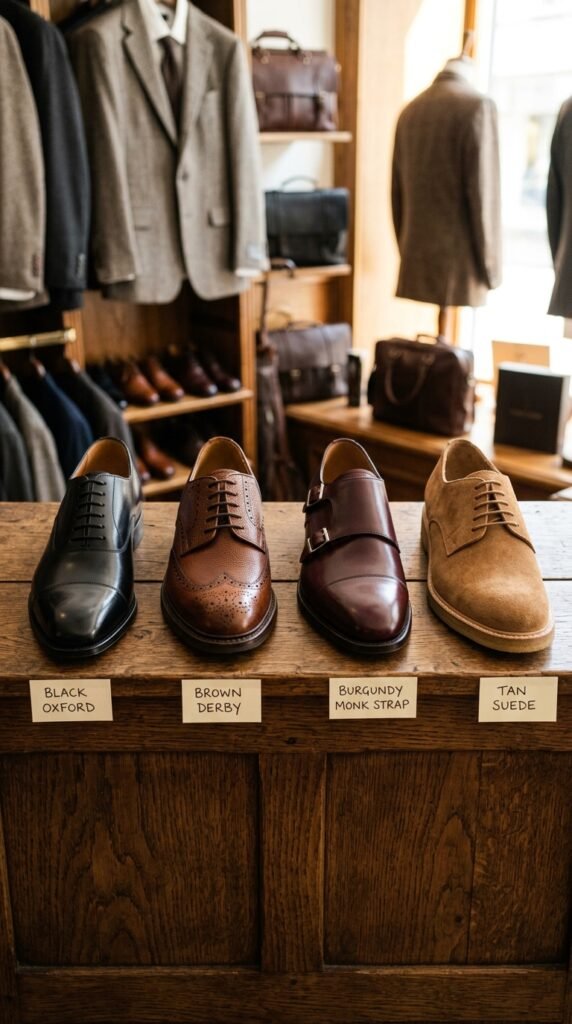
Derby, double monk strap, or penny loafer
Tier 5 — Relaxed Tailoring
Weekend, creative settings
Suede Derby or tassel loafer
The rule of thumb: never drop more than one tier below your suit’s formality level. A Tier 2 suit with a Tier 4 shoe creates visual tension. A Tier 2 suit with a Tier 3 shoe reads as intentionally relaxed.
Rule 2: The Oxford Cap-Toe Is the Universal Default
If you own one pair of dress shoes for your 3-piece suits, it should be an Oxford cap-toe — the most versatile, most universally appropriate shoe in menswear.
Why it works with every 3-piece configuration:
The closed lacing system creates a sleek, unbroken line that mirrors the suit’s structured silhouette
The cap-toe detail adds visual interest without competing with the waistcoat
Available in every colour from black to tan, accommodating any suit palette
Specification benchmark: Look for a shoe with a single leather sole (approximately 5mm thickness), a close-trimmed welt, and a last shape that tapers without becoming excessively pointed. Tailoring experts agree that the toe shape should echo the lapel style — rounded toes with notch lapels, slightly chisel toes with peak lapels.
Rule 3: Colour-Match by Suit, Not by Belt
The old rule was “match your shoes to your belt.” The modern rule is more nuanced: match your shoes to your suit’s visual temperature first, then coordinate the belt.
Here’s the definitive colour-matching guide:
Charcoal suit → Black or dark burgundy shoes
Navy suit → Dark brown, burgundy, or oxblood shoes (never black — the contrast is too stark for daytime)
Light grey suit → Medium brown, cognac, or tan shoes
Stone/beige suit → Medium-to-light brown or suede in tobacco tones
Pale blue suit → Cognac or warm brown shoes
The data point: According to a GQ style analysis, brown shoes outsell black shoes 3:1 among men aged 25–40 purchasing for professional wardrobes — a clear signal that the “black shoes only” era is definitively over.
Rule 4: Consider the Trouser Break
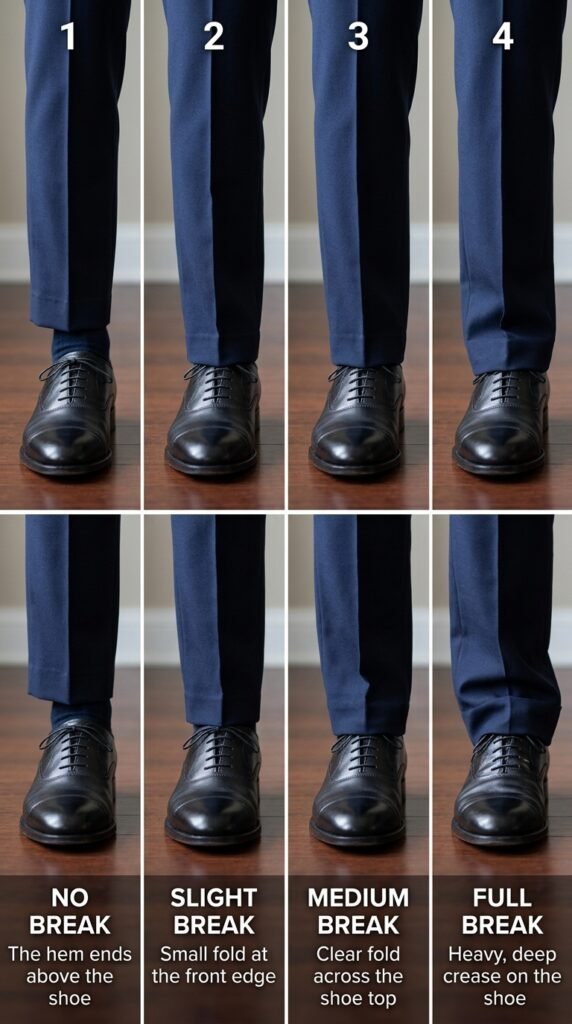
The trouser break — where the hem meets the shoe — is the precise point where tailoring and footwear intersect physically. The wrong break length can ruin an otherwise perfect pairing.
2026 industry standards for trouser breaks with 3-piece suits:
No break (clean crop): Best with low-profile shoes like Oxfords and single monks. Trouser hem should graze the top of the shoe with zero fabric pooling. Ideal trouser-opening circumference: 38–40cm.
Half break (slight fold): The most versatile option. Works with all shoe styles. Creates one soft fold where fabric meets the shoe’s vamp.
Full break: Appropriate only with heavier winter fabrics. Avoid with sleek, modern shoe shapes — the excess fabric obscures the shoe’s lines.
The rule of thumb: the sleeker the shoe, the shorter the break.
When your 3-piece suit is configured for less formal settings — summer weddings, evening dinners, creative industry events — the Derby shoe becomes your most powerful option.
The Derby’s open lacing system creates a slightly more relaxed visual signature than the Oxford’s closed construction. This subtle difference signals “intentionally approachable” rather than “boardroom formal.”
Best Derby pairings for 3-piece suits:
Navy linen 3-piece + tan grain-leather Derby
Light grey flannel 3-piece + dark brown suede Derby
Stone cotton 3-piece + chocolate burnished Derby
Explore our 3-Piece Suits collection for seasonal configurations designed to pair with both Oxford and Derby styles.
Rule 6: Monk Straps Add Modern Character
Single and double monk strap shoes occupy a unique position in the formality hierarchy — slightly below Oxfords, slightly above Derbies, and distinctly more characterful than both.
Selection guidance:
Single monk straps lean formal. Pair with business and professional 3-piece configurations.
Double monk straps lean contemporary. Pair with smart-casual 3-piece suits or when the jacket will be removed to feature the waistcoat prominently.
The critical detail: The buckle metal should coordinate with your other hardware. If your waistcoat has brass buttons, a brass-toned buckle creates subconscious cohesion. If your watch has a silver case, a nickel buckle completes the loop.
Tailoring experts agree that suede dress shoes are one of the most underutilised tools in warm-weather 3-piece suiting. The texture of suede creates a visual softness that balances the structured formality of a waistcoat-anchored outfit.
When suede works:
Suits in linen, cotton-linen blends, or fresco wool
Daytime events in natural lighting
Smart-casual configurations where the tie is absent
When suede fails:
Rainy or wet conditions (obvious, but frequently ignored)
Formal business settings where a leather sole and polished finish are expected
With heavily patterned suits — the texture competition becomes overwhelming
Recommended shades: Tobacco, snuff brown, and slate grey. Avoid navy suede shoes — they clash with navy suits and look incongruous with everything else.
Rule 8: Sole Construction Signals Quality
A shoe’s sole is its structural foundation. The construction method directly impacts how the shoe looks, sounds, and ages alongside your 3-piece suit.
The hierarchy:
Goodyear-welted leather sole — The gold standard. Resoleable, elegant, and the benchmark for formal dress shoes. Brands like Crockett & Jones, Church’s, and Edward Green build on this method exclusively.
Blake-stitched leather sole — Sleeker profile, more flexible, but less resoleable. Common in Italian shoemaking from makers like Santoni.
Leather sole with rubber topy — A practical compromise. Maintains the visual of a leather sole while adding grip and waterproofing on the bottom.
Full rubber sole — Acceptable only in smart-casual or relaxed configurations. Avoid with formal 3-piece suits entirely.
The rule of thumb: if your suit has full canvas construction, your shoes should have welted leather soles. Construction quality should be consistent from head to toe.
Rule 9: Shoe Patina Should Complement, Not Compete
In 2026, hand-patinated and burnished dress shoes continue their ascent as the preferred choice among discerning men. The subtle colour variation — darker at the toe and heel, lighter through the vamp — adds depth and character.
Pairing patinated shoes with 3-piece suits:
A burgundy-to-oxblood patina works exceptionally with charcoal and navy suits
A cognac-to-brown gradation elevates light grey and stone suits
A tan-to-honey burnish pairs beautifully with summer-weight pale blue suits
The caution: Avoid heavily distressed or “museum calf” finishes with pristine, sharply pressed 3-piece suits. The contrast between a rough, aged shoe and a crisp new suit creates a dissonance that reads as costume rather than style.
Rule 10: Maintain a Shoe Rotation System
A quality dress shoe paired with a 3-piece suit absorbs moisture, stress, and heat throughout a full day of wear. Without adequate rest between wears, even the finest footwear deteriorates rapidly.
The minimum standard:
Own at least 3 pairs of dress shoes in rotation for regular suit-wearing
Allow 48 hours minimum between wears for the same pair
Use cedar shoe trees inserted immediately after removal — they absorb moisture and maintain the shoe’s last shape
Polish or cream-condition shoes every 4–5 wears
A well-maintained £200 shoe that’s been properly rotated will outlast and outperform a £500 shoe worn daily without rest. This is not opinion — it is the established consensus among cordwainers and leather specialists.
The Complete Colour-Pairing Matrix: 3-Piece Suit to Dress Shoe
Suit Colour
Best Shoe Colour
Shoe Style
Sock Recommendation
Charcoal
Black, dark burgundy
Oxford cap-toe
Charcoal or black
Navy
Dark brown, oxblood
Oxford, monk strap
Navy or burgundy
Mid-Grey
Medium brown, cognac
Oxford, Derby
Grey or light brown
Light Grey
Cognac, tan
Derby, monk strap
Light grey or oatmeal
Stone/Beige
Medium brown, tobacco suede
Derby, loafer
Beige or sand
Pale Blue
Warm brown, cognac
Derby, suede Derby
Light blue or grey
Olive/Sage
Dark brown, chocolate
Derby, monk strap
Olive or dark brown
Sock note: The industry standard for 2026 is matching socks to the trouser, not the shoe. This creates an unbroken visual line from trouser to ankle. Novelty or patterned socks are acceptable only in explicitly casual contexts.
Complement your shoe-suit pairings with properly fitted shirts from our Formal Shirts collection.
Frequently Asked Questions
What shoes go best with a 3-piece suit?
Oxford cap-toe shoes in black or dark brown are the most universally appropriate choice to pair a 3-piece suit with dress shoes. For business formal settings, a closed-lacing Oxford is the industry standard. For smart-casual events, Derby shoes and monk straps offer refined versatility. Tailoring experts agree that the shoe’s formality level should always match the suit’s — never more than one tier below.
Can you wear loafers with a 3-piece suit?
Yes, but only in smart-casual or relaxed configurations. Penny loafers and tassel loafers work with summer-weight 3-piece suits in linen or cotton-linen blends, particularly when the jacket is likely to be removed. Avoid loafers with structured, formal 3-piece suits in worsted wool — the formality gap creates a visual imbalance that undermines the outfit’s coherence.
Should dress shoes be darker or lighter than the suit?
The rule of thumb is that shoes should generally be darker than the suit or at least equal in visual depth. A dark brown shoe with a light grey suit creates a grounded, anchored look. A shoe that is lighter than the suit — for example, tan shoes with a charcoal suit — can look disconnected and bottom-heavy. The one exception is black suits, where only black shoes are appropriate regardless.
How important is shoe quality when wearing a 3-piece suit?
Extremely important. A 3-piece suit concentrates visual attention on details, and shoes are the detail observed most critically. Tailoring experts agree that a Goodyear-welted or Blake-stitched leather shoe is the minimum quality standard for suits with full or half-canvas construction. Budget approximately 25–30% of your total suit outfit investment on footwear — a ratio that consistently produces the most balanced results.
Do brown shoes work with a black 3-piece suit?
No. Tailoring consensus holds that black suits demand black shoes in every formal and professional context. The brown-with-black combination lacks sufficient contrast harmony and reads as a colour-matching error rather than a deliberate style choice. If you prefer brown shoes, redirect toward charcoal or navy suits where brown is not only acceptable but often the superior option.
Final Perspective
The ability to pair a 3-piece suit with dress shoes correctly is not a trend — it’s a permanent skill. The ten rules above aren’t subject to seasonal revision or fashion-cycle shifts. They’re rooted in the structural logic of how garments and footwear interact visually, proportionally, and materially.
Invest in understanding these relationships once, and every suit you wear from this point forward will carry the quiet authority of a man who knows exactly what he’s doing — from lapel to lace.
Share your love
Newsletter Updates
Enter your email address below and subscribe to our newsletter