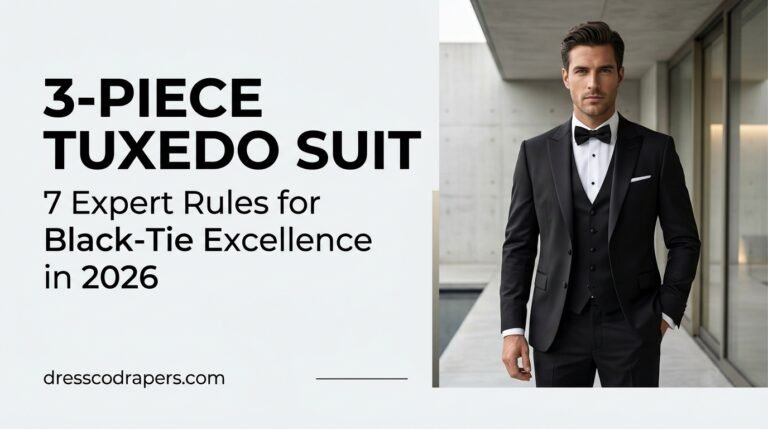
3 Piece Slim Suit: 7 Undeniable Benefits That Deliver a Modern, Tailored Look
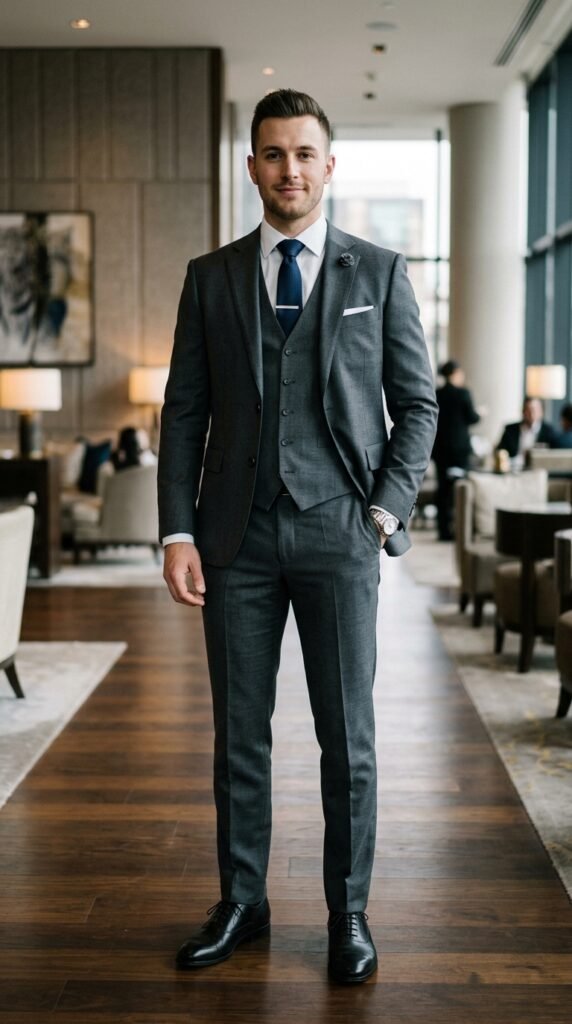
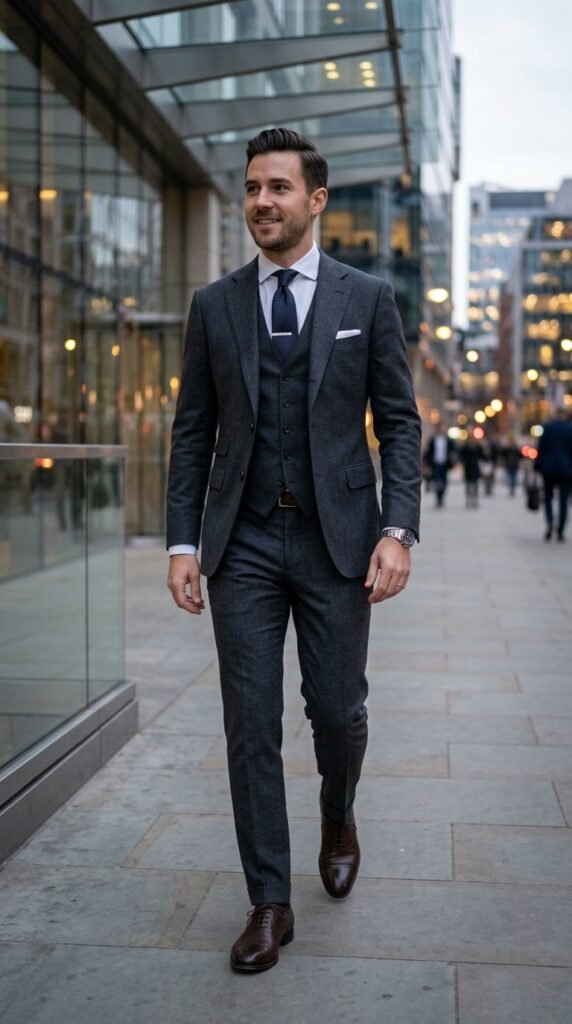
A 3 piece slim suit is not simply a narrower version of a traditional suit. It is a precisely engineered garment system—jacket, waistcoat, and trousers—designed to sculpt your natural frame into a silhouette that communicates discipline, taste, and modern sophistication.
For men between 25 and 40 who are building a wardrobe that performs in boardrooms, at weddings, and across every high-stakes moment in between, the 3 piece slim suit is arguably the single most versatile investment you can make.
At Dressco Drapers, we specialize in luxury menswear and bespoke tailoring. We have fitted hundreds of clients in slim-cut three-piece ensembles, and we have seen firsthand how the right construction, fabric, and fit transform not just appearance but posture, confidence, and the way a man carries himself through every room he enters.
This is not surface-level styling advice. This is a complete, expert-led guide covering technical tailoring details, fabric science, fit precision, and the 2026 trends that are reshaping how the modern 3 piece slim suit looks and feels.
What Is a 3 Piece Slim Suit and Why Does It Define Modern Tailoring?
A 3 piece slim suit consists of three coordinated garments—jacket, trousers, and waistcoat—cut from the same cloth in a slim, body-conscious silhouette. The “slim” designation refers to specific proportions throughout:
Narrower lapels (typically 7–8 cm versus 9–10 cm in classic cuts).
Higher armholes that sit closer to the underarm for cleaner movement.
Suppressed waist on the jacket for a defined torso shape.
Tapered trouser legs that narrow from thigh to ankle without constriction.
A shorter jacket body that typically ends at mid-hip rather than covering the full seat.
The waistcoat distinguishes it from a standard two-piece. This third layer adds visual depth, formality, and an additional styling dimension that two-piece suits simply cannot replicate.
The slim fit itself reflects where modern tailoring has been heading for over a decade—toward cleaner lines, less excess fabric, and garments that follow the body’s natural contours rather than draping loosely over them.
In 2026, this silhouette is not “trendy.” It is the established standard of contemporary menswear.
The Anatomy of a 3 Piece Slim Suit: Construction Details That Separate Quality From Compromise
Before you evaluate color, pattern, or price, you must understand construction. This is where most men get it wrong—and where Dressco Drapers’ expertise matters most.
Jacket Construction
The most critical quality indicator is the interlining method:
Full-canvas: A horsehair canvas chest piece is hand-stitched between the outer fabric and lining. Over time, it molds to your chest, creating a natural, personalized drape. This is the gold standard.
Half-canvas: Canvas covers the chest and lapels; the lower portion uses fusible interlining. An excellent middle ground between quality and value.
Fully fused: Adhesive bonds the interlining to the outer fabric. Cheaper to produce, but the bond degrades with dry cleaning, causing bubbling and a stiff, lifeless appearance.
For a slim-cut jacket, canvas construction is especially important. The closer-to-body fit means any structural flaw—bubbling, puckering, stiffness—is immediately visible.
Stitches per inch (SPI): Quality jackets feature 8–10 SPI on structural seams. Pick stitching along lapel edges at 5–6 SPI indicates hand-finishing, a hallmark of bespoke and high-end ready-to-wear.
Waistcoat Precision in a 3 Piece Slim Suit
In a slim silhouette, the waistcoat must be impeccably fitted. There is zero room for error.
The waistcoat must sit flush against the torso without button pull or gapping.
The bottom edge must fully cover the trouser waistband—no shirt visible between vest and trousers.
Single-breasted waistcoats with 5–6 buttons are the modern slim-suit standard.
The back panel should feature an adjustable cinch strap for fine-tuning fit as your body shifts throughout the day.
Waistcoat length in slim suits runs slightly shorter than classic cuts, ending approximately 2–3 cm below the trouser waistband.
Trouser Details
Slim suit trousers demand precision from waist to ankle:
Flat-front construction is non-negotiable for the slim aesthetic. Pleats add volume that contradicts the streamlined intent.
A medium-to-low rise pairs naturally with slim jackets, though a medium rise offers better waistcoat coverage.
Trouser taper should narrow progressively from the knee to a leg opening of 16–17 cm for most body types.
Minimal break—the fabric should barely kiss the top of the shoe. No pooling. No stacking. Clean termination.
7 Undeniable Benefits of Wearing a 3 Piece Slim Suit
1. It Sculpts a Streamlined Silhouette That Flatters Every Frame
The slim cut eliminates excess fabric that gathers, bunches, and blurs your natural shape. Combined with a waistcoat that defines the torso, the result is a clean V-shaped line from shoulder to waist that is universally flattering.
For leaner builds, it creates presence without bulk. For athletic frames, it showcases proportion. For broader physiques, the structured lines channel the eye vertically.
2. It Projects Contemporary Professionalism
Classic suits communicate tradition. A 3 piece slim suit communicates that you respect tradition and understand where menswear is heading. In 2026, this distinction matters enormously in industries that value forward thinking.
Hiring managers, clients, and collaborators register this signal—often unconsciously.
3. It Multiplies Your Wardrobe Options
A single 3 piece suit yields at minimum five distinct outfits:
Full three-piece for formal occasions.
Jacket and trousers for standard business settings.
Waistcoat and trousers for smart-casual environments.
Waistcoat over a dress shirt with jeans for elevated casual wear.
Jacket with contrasting chinos for weekend refinement.
This versatility delivers exceptional cost-per-wear value.
4. The Waistcoat Adds Functional Warmth Without Bulk
In cooler months, the waistcoat provides an insulating layer equivalent to a light sweater—without adding any visible volume to the slim silhouette. Wool waistcoats in 260–320 GSM fabrics trap heat effectively against the torso.
In warmer months, lighter waistcoats in 180–220 GSM tropical wool keep the layered aesthetic breathable.
5. It Enhances Posture and Physical Presence
A well-fitted slim jacket with structured shoulders naturally encourages you to stand taller and move more deliberately. The waistcoat gently reinforces core alignment. The combined effect is visible in every photograph, handshake, and presentation.
6. It Separates You From Two-Piece Uniformity
Count the suits at your next professional event. The overwhelming majority will be two-piece. The man in a slim three-piece occupies a different category entirely—one that signals intentionality and elevated standards.
7. It Transitions Seamlessly Across Formality Levels
Few garments move between black-tie-optional galas, executive meetings, creative workplaces, and evening dinners with this much ease. The 3 piece slim suit handles every context by simply adjusting accessories and removing or adding layers.
When to Wear a 3 Piece Slim Suit for Maximum Impact
Strategic deployment amplifies this suit’s power.
Formal and professional settings:
Executive presentations and client pitches
Job interviews for senior-level roles
Weddings (as groom, groomsman, or guest)
Award ceremonies and industry galas
Black-tie-optional events
Semi-formal and smart-casual settings:
Upscale dinner dates and restaurant evenings
Networking events and launch parties
Creative workplace environments
Weekend brunches (waistcoat + trousers, no jacket)
The guiding principle: A 3 piece slim suit almost never overcorrects for formality. When uncertain, it is the safest high-impact choice in your wardrobe.
How to Style a 3 Piece Slim Suit Like a Professional Tailor
Shirt Selection for a 3 Piece Slim Suit
The shirt beneath a slim suit must be equally refined in fit. A baggy shirt beneath a fitted jacket destroys the silhouette instantly.
Fabric: Opt for 100–120 two-ply cotton in poplin or twill weaves. These drape cleanly against the torso without bunching under the waistcoat.
Collar: A semi-spread or cutaway collar works best—these styles complement the narrower lapels of slim-cut jackets and sit well above the waistcoat neckline.
Color for formal contexts: White or light blue. These are non-negotiable foundations.
Color for creative settings: Pale pink, lavender, or subtle micro-patterns add personality without volume.
Explore our curated range of formal shirts designed specifically for layered slim tailoring.
Shoe Pairings That Complete the Modern Silhouette
Slim suits demand footwear with sleek proportions. Bulky, round-toed shoes contradict the streamlined intent.
Black cap-toe Oxfords: The definitive formal choice for charcoal, navy, and black slim suits.
Dark brown Derbies: Slightly less formal, ideal for medium grey and earthy tones.
Double monk straps: A confident, modern choice that pairs exceptionally well with slim trousers.
Suede loafers: Appropriate only for smart-casual contexts when the jacket is removed.
Chelsea boots: A contemporary alternative that works with slim tapered trousers, especially in autumn/winter.
Essential rule: Belt color, finish, and leather type must match your shoes precisely. In slim suits, where every detail is visible and accentuated, a mismatch is glaringly obvious.
Accessories: The Details That Define You
With a slim silhouette, accessories become focal points. Choose wisely.
Ties: Slim ties (6–7 cm width) maintain proportional harmony with narrower lapels. Silk grenadine, knit ties, and textured wool ties in solid tones—burgundy, navy, forest green, steel blue—work across seasons.
Pocket squares: A white linen pocket square in a clean TV fold is timelessly correct. For personality, choose a complementary (never matching) color to your tie.
Cufflinks: Understated silver or gunmetal in geometric designs. Reserve novelty cufflinks for contexts where they are genuinely appropriate—which is rarely.
Watch: A slim dress watch (under 10mm case thickness) slides beneath shirt cuffs without snagging or creating bulk under the jacket sleeve.
Tie bars: Position horizontally between the third and fourth shirt buttons. The bar should be narrower than the tie width—never equal to or wider.
Fabric Guide: Choosing the Right Material for Every Season
Fabric selection is the foundation of comfort, drape, and longevity. For slim-cut suits, fabric must have enough body to hold the tailored shape while remaining soft enough to move with you.
Super 100s–110s: Durable, resilient, excellent for daily-wear slim suits. Ideal starting point.
Super 120s–130s: The sweet spot—refined feel, good durability, moderate wrinkle resistance. Best for professional slim suits.
Super 140s–150s: Luxuriously soft but more delicate. Best reserved for special-occasion suits that see less frequent wear.
Super 160s+: Exquisite hand feel, but fragile. These require careful handling and are not recommended for everyday 3 piece slim suits.
For slim construction specifically, fabrics with moderate body (Super 110s–130s) perform best. Excessively fine fibers may not hold the close-fitting structure under the stress of daily movement.
2026 Trends Redefining the 3 Piece Slim Suit
The slim three-piece continues to evolve. Here is what the 2026 fashion season introduces.
Refined Relaxation in the Slim Silhouette
The 2026 slim suit is not skin-tight. The industry has recalibrated, moving away from the ultra-narrow fits of the 2010s toward a “refined slim”—still body-conscious, but with an additional 1–2 cm of ease through the chest and thigh. The result is a silhouette that looks sharp but feels entirely comfortable for all-day wear.
Muted, Sophisticated Color Palettes
Beyond traditional navy and charcoal, the 2026 palette introduces slate blue, soft olive, warm taupe, dusty sage, and muted terracotta into slim suit collections. These colors feel distinctly modern while remaining versatile enough for professional environments.
Textured Fabrics Over Plain Weaves
Flat, smooth fabrics are giving way to micro-herringbone, birdseye, hopsack, and pinhead weaves. These textures add visual depth and interest without pattern—ideal for the man who wants distinction without loudness.
Performance-Enhanced Natural Fibers
Fabric mills are producing natural stretch wools (with 2–3% elastane), wrinkle-recovery finishes, and moisture-wicking merino blends that perform like technical fabrics while looking and feeling like luxury tailoring. For slim suits that move with you through a 14-hour day, these innovations are transformative.
Contrast Waistcoats as a Statement
One of the boldest 2026 trends: pairing a textured or subtly patterned waistcoat with a solid slim suit. Think a charcoal hopsack vest under a navy suit, or a checked wool waistcoat under solid mid-grey. This adds dimension and personality while maintaining cohesion.
Sustainability as a Quality Marker
Recycled merino, organic cotton linings, and naturally sourced horn buttons are no longer niche. In 2026, sustainability is a signal of quality craftsmanship, not compromise.
Buying Guide: Selecting Your Perfect 3 Piece Slim Suit
Follow this structured checklist to make an informed investment.
Assess your body honestly. Slim does not mean tight. The suit should follow your contours with approximately 1–2 cm of ease throughout. If buttons strain or fabric pulls horizontally, size up and have the suit tailored.
Start with a versatile foundation color. Navy, charcoal grey, or medium grey. These work for 90% of occasions and pair with virtually any shirt and accessory combination.
Inspect construction quality.
Check for canvas interlining (feel for the soft, independent layer between outer fabric and lining in the chest area).
Examine buttonholes for clean, tight stitching.
Verify lining quality—Bemberg (cupro) linings breathe and slide better than polyester.
Test the waistcoat independently. Stand in front of a mirror wearing only the waistcoat and shirt. Does it look intentional and complete? Can you see any shirt between the vest bottom and trouser waistband? It must pass this test.
Evaluate trouser taper. The leg should narrow cleanly from knee to ankle. Try them with the shoes you plan to wear—the break point is critical in slim trousers.
Budget for tailoring adjustments. Even the best off-the-rack slim suit benefits from minor alterations. Sleeve length, trouser hemming, and waist suppression adjustments cost relatively little but deliver disproportionate impact.
Consider bespoke or made-to-measure for optimal results. At Dressco Drapers, our 3 piece suit collection is crafted with every construction detail discussed in this guide.
Care and Maintenance: Protecting Your Investment
Slim suits reveal wear and neglect faster than relaxed-fit alternatives. Every wrinkle, stain, and structural flaw is accentuated by the close-fitting silhouette.
After Every Wear
Hang immediately on a wide, contoured wooden hanger. Wire and plastic hangers distort the shoulder line—especially critical in slim-cut jackets with minimal padding.
Brush with a natural bristle garment brush in the direction of the fabric’s nap. This removes surface dust, lint, and micro-debris that accumulate throughout the day.
Empty all pockets. Weighted pockets distort the slim trouser drape and jacket lines over time.
Allow 24–48 hours rest between wears. Rotating suits lets wool fibers recover their shape naturally.
Cleaning Protocol
Dry clean sparingly: Maximum 2–3 times per year. Over-cleaning strips natural lanolin from wool fibers, causing premature aging, loss of drape, and fabric thinning.
Spot clean immediately when stains occur. Blot—never rub—with a damp cloth and mild detergent.
Steam between cleanings to remove light wrinkles and refresh fabric. A handheld garment steamer is an essential tool for slim suit ownership.
Never iron directly on the suit fabric surface. If pressing is necessary, use a pressing cloth to prevent shine marks.
Long-Term Storage
Store in a breathable cotton garment bag. Avoid plastic, which traps moisture and promotes mildew.
Add cedar blocks or rings to the closet for natural moth deterrence. Avoid chemical mothballs.
Keep suits in a cool, dry space away from direct sunlight, which fades fabric color over time.
Common Mistakes That Ruin a 3 Piece Slim Suit
Even style-conscious men make these errors. Avoid them completely.
Wearing a suit that is too tight. Slim is not skinny. If the jacket pulls across the back, buttons strain at the closure, or trouser pockets flare open, the fit is too aggressive. Size up and tailor down.
Visible shirt gap below the waistcoat. The vest must fully cover the trouser waistband at all times—standing, sitting, and reaching.
Buttoning the bottom waistcoat button. The last button always stays undone. Always. No exceptions.
Ignoring proportional harmony. Lapel width, tie width, collar spread, and pocket square fold should all exist within a similar visual scale. In slim suits with narrower lapels, a wide tie or oversized pocket square creates jarring imbalance.
Wearing bulky shoes. Chunky soles and round toes contradict the streamlined trouser silhouette. Opt for sleek, narrow-profile footwear.
Over-accessorizing. A slim suit is already visually assertive through its cut alone. A tie, pocket square, and watch are sufficient. Adding a lapel pin, tie bar, bracelet, and statement ring simultaneously creates visual noise.
Neglecting undershirt visibility. In slim suits, undershirt lines show through dress shirts more readily. Choose a V-neck in a skin-matching tone that remains invisible under the collar opening and through lighter fabrics.
FAQs About 3 Piece Slim Suits
Can a 3 piece slim suit be comfortable for all-day wear?
Absolutely. Modern slim suits incorporate natural stretch fabrics (wool with 2–3% elastane) and higher armholes that allow full range of motion. The key is ensuring the suit has adequate ease—approximately 1–2 cm beyond your body measurements through the chest and thigh. A well-fitted slim suit should feel like a second skin, not a constraint.
Is a 3 piece slim suit suitable for shorter men?
Yes—it is arguably the most flattering suit cut for shorter frames. The vertical lines of a slim silhouette elongate the body visually. Pair with medium-rise trousers to lengthen the leg line, keep the jacket length proportionate (it should not extend past mid-hip), and opt for a minimal trouser break to maximize the visual length of the leg.
What is the difference between slim fit and tailored fit?
Slim fit refers to a standardized, narrower pattern with reduced ease throughout the garment—typically 4–6 cm of ease through the chest. Tailored fit (or “regular fit with tailoring”) starts with a standard pattern adjusted to your specific body measurements, which may or may not result in a slim silhouette. For true precision, bespoke or made-to-measure combines the slim aesthetic with custom patterning for your unique body.
What colors are most versatile for a 3 piece slim suit?
Navy, charcoal, and medium grey form the essential foundation. These work across formal and semi-formal contexts and pair with virtually any shirt and tie combination. Once you own one of these, consider expanding into slate blue, olive, or warm taupe for seasonal variety—all strong choices for the 2026 palette.
Can I wear a 3 piece slim suit to a summer wedding?
Yes. Choose lightweight fabrics like tropical wool or linen-wool blends in 180–220 GSM weights. Lighter colors—light grey, stone, pale blue—keep you cool while maintaining the structured silhouette. If the ceremony is outdoors, remove the jacket for the reception and let the waistcoat carry the formality.
How much should I invest in a quality 3 piece slim suit?
Quality requires meaningful investment. Focus on natural fabrics, canvas construction, and precise fit rather than brand names alone. A well-made 3 piece slim suit from a reputable house like Dressco Drapers delivers value across years of wear—not a single season. Consider it a cost-per-wear investment, not a one-time expense.
The Final Verdict: A 3 Piece Slim Suit Delivers the Modern, Tailored Look You Want
The question was never really if a 3 piece slim suit can give you a modern, tailored look. It was whether you would invest in one that is built correctly, fitted precisely, and styled with intention.
The answer, backed by every technical detail in this guide, is unequivocal. A well-constructed 3 piece slim suit sculpts your silhouette, multiplies your wardrobe options, transitions effortlessly across occasions, and communicates a level of personal standard that two-piece suits and casual alternatives simply cannot match.
In 2026, with refined slim proportions, textured fabrics, sophisticated muted palettes, and performance-enhanced natural fibers, this silhouette has never been more relevant or more wearable.
Explore the complete Dressco Drapers 3 piece suit collection and discover what expert tailoring, premium construction, and a precisely fitted 3 piece slim suit feel like—designed around your body, your life, and your standards.